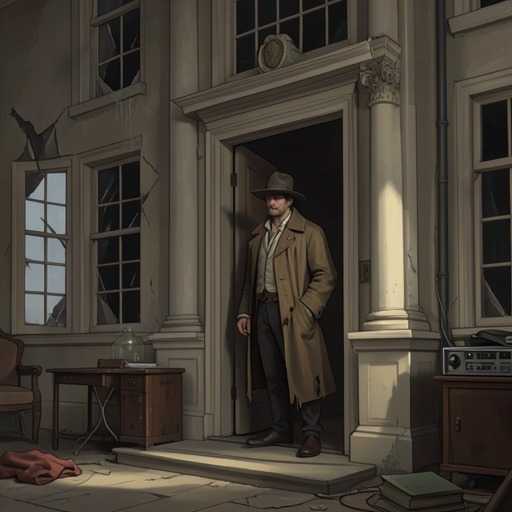
Pulushkin's manor
Dead SoulsPlyushkin’s estate is a landscape of neglected buildings and hoarded wealth, where the abundance of a large landholding has curdled into disorder. Its village and mansion make material decay visible, while the transaction between Plyushkin and Chichikov turns that setting into a decisive stop in Chichikov’s journey: the proprietor agrees to transfer the tax obligation attached to deceased serfs, and the estate’s ruinous domestic order exposes the human consequences of his miserliness.
Arrival and the Village
Chichikov’s visit follows his departure from Sobakevitch’s estate. Dissatisfied with the price he has paid there, and unwilling for Sobakevitch to learn where he is going, he has Selifan take the britchka out of sight of the mansion. He asks a peasant how to reach Plyushkin’s property without passing the house he has just left. The question briefly puzzles the man, whose eventual blunt answer amuses Chichikov on the way to the next estate.
The journey into Plyushkin’s village offers no smooth passage into a prosperous household. Its wooden pavement jolts the carriage, and the buildings show conspicuous signs of age: hut beams have darkened, roofs are pierced or largely gone, and some structures have been reduced to their framework. The narrator suggests that residents may have removed roof timbers because the damaged huts no longer keep out the rain. The estate’s disorder is thus visible before its proprietor appears: it is not merely a neglected room inside an otherwise thriving domain, but a deterioration extending across the village.
The Mansion and Its Interior
At the mansion, a roughly dressed woman tells Chichikov that the master is away, then directs him into the house. The first rooms are dark and strikingly untidy. In the parlour, old possessions accumulate without apparent order: a clock lacking its pendulum, old silver and china, damaged furniture, a shrunken lemon, papers, and other discarded objects. Cobwebs cover the clock; dust lies so thickly over a heap of items that touching it would leave a hand looking gloved. The room’s objects range from things that might still be useful to things whose value has almost disappeared, all gathered together rather than maintained or put to clear use.
The mansion’s atmosphere is rendered through this accumulation, not through a single sign of poverty. The writing table still holds manuscripts and old books; a cupboard contains silver, glassware, and china; yet these coexist with broken furniture, neglected utensils, and refuse-like clutter. The contrast points to an estate that possesses goods but has lost the habits of care and management that would make possession meaningful. The house is full, but its fullness registers as abandonment.
Plyushkin and the Estate’s Contradiction
When Chichikov asks where the master is, the ragged figure before him replies that he is the master himself. Plyushkin’s appearance initially makes him seem like a beggar, and the narrator contrasts that impression with the reality of his position: he owns a thousand serfs and storehouses filled with flour, grain, cloth, linen, and sheepskins. The estate’s defining contradiction is therefore not simple destitution. It is the coexistence of substantial resources with visible neglect, a contradiction embodied by a proprietor whose clothing and household conceal rather than express his wealth.
That contrast also shapes Plyushkin’s response to Chichikov. When Chichikov offers sympathy, Plyushkin dismisses sympathy that brings no material benefit, recalling a kinsman who expresses concern but has squandered his money. Chichikov then distinguishes his own offer from empty words: he proposes to assume the taxes owed on the deceased serfs. Plyushkin is astonished by the proposal and asks whether Chichikov has served in the military; Chichikov replies that he has been in the civil service. The negotiation emerges from the estate’s particular conditions, where deceased serfs still carry a financial obligation and a transfer of that burden can appear to the proprietor as immediate relief.
Transaction and Aftermath
Plyushkin accepts Chichikov’s practical offer, and the transaction links the estate’s decaying world to the novel’s system of taxation and property. The deceased serfs are treated as entries carrying a continuing tax liability, and Chichikov’s willingness to assume that liability converts them into the subject of a purchase. The exchange is presented not as an abstract scheme alone but as a meeting between two forms of acquisitiveness: Chichikov seeks advantage through the dead serfs’ legal status, while Plyushkin’s concern with money makes even the prospect of generosity legible as a financial matter.
After Chichikov leaves, Plyushkin closes the gates, checks that the watchmen are at their posts, visits the kitchen, and scolds the servants for theft and bad conduct. He eats some cabbage soup and gruel there before returning to his room to consider how to repay his guest. His thoughts settle on a silver watch, first as a present and then as a keepsake to be left in his will. This imagined repayment does not undo the estate’s neglect; instead, it reveals how even gratitude is drawn into the logic of keeping and bequeathing possessions. The visit ends with a glimpse of an impulse toward reciprocity, confined within the same hoarding world that has made the mansion and village decay.
Place in the Novel’s Landscape
The estate belongs to a larger contrast between land as a living field of seasonal work and land as neglected property. Later, Kostanzhoglo describes an estate organized around the changing year: preparing seed and workers, sowing, harvesting, storing grain, and maintaining mills and buildings. His account makes care for land and productive labor the condition of both material prosperity and meaningful rural life. Set beside that ideal, Plyushkin’s estate is marked by the absence of sustained care: its roofs fail, household goods gather dust, and wealth accumulates without restoring order.
The novel’s roads also bind the estate to a chain of encounters rather than presenting it as an isolated world. Chichikov reaches it by choosing a route that conceals his destination from Sobakevitch, and his journey is repeatedly shaped by weather, mud, crossroads, and the condition of the way. Against that moving frame, the decayed village and cluttered mansion form a pause in which the consequences of property and neglect become sharply visible. Plyushkin’s estate is therefore both a stop in Chichikov’s pursuit of dead souls and a concentrated portrait of wealth deprived of stewardship.